
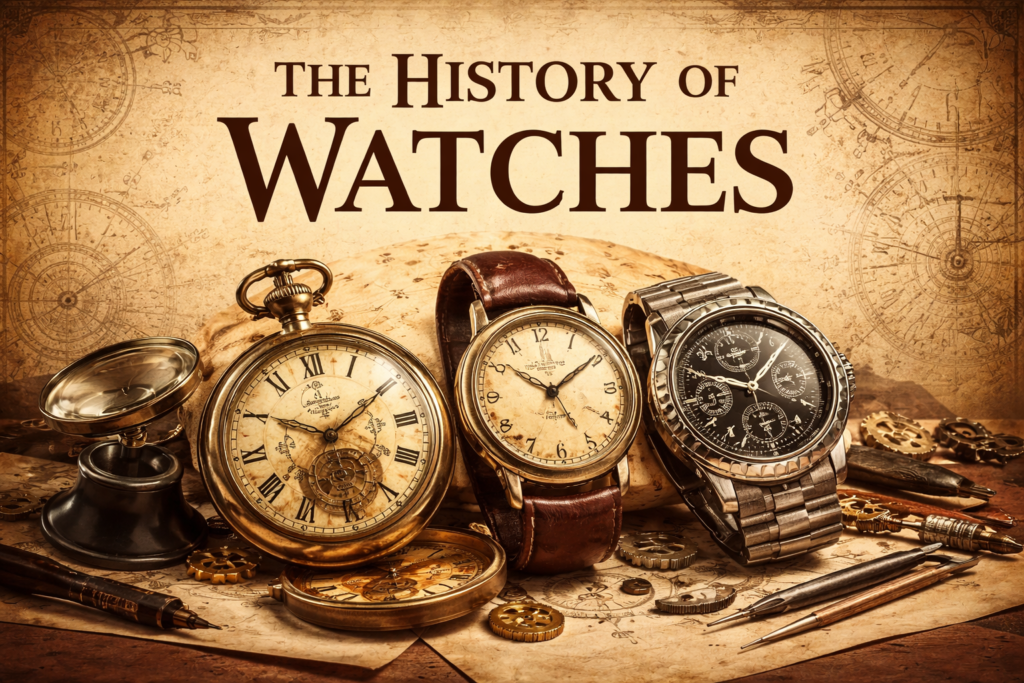
Introduction istory of watches
Watches are more than just timekeeping devices—they reflect human innovation, craftsmanship, and style. From ancient methods of tracking time to modern smartwatches, the evolution of watches tells a story of science, art, and technology.
🌞 Early Timekeeping Devices
Before watches existed, people relied on nature and simple tools to measure time.
- Sundials (around 1500 BCE): Used the position of the sun’s shadow
- Water clocks: Measured time using controlled water flow
- Hourglasses: Used sand to track intervals
These early inventions laid the foundation for mechanical timekeeping.
⚙️ The Birth of Mechanical Watches (16th Century)
The first portable watches appeared in the 1500s in Europe.
- Early watches were called “clock watches”
- They were large, often worn as pendants
- Accuracy was limited, often off by hours per day
Despite their flaws, they became symbols of wealth and status.
⛓️ Pocket Watches (17th–19th Century)
Pocket watches became popular among men, especially during the industrial revolution.
- Smaller and more accurate than earlier designs
- Introduced minute and second hands
- Widely used by railway workers for precise timing
They represented elegance and precision.
⌚ Wristwatches (20th Century Revolution)
Wristwatches became mainstream during World War I.
- Soldiers needed quick access to time
- Wristwatches replaced pocket watches
- Became popular for both men and women
By mid-century, wristwatches were a global fashion statement.
🔋 Quartz Watches (1960s–1980s)
The invention of quartz technology revolutionized watchmaking.
- Powered by batteries instead of winding
- Extremely accurate and affordable
- Led to the “Quartz Crisis” in traditional watchmaking
Quartz watches made timekeeping accessible to everyone.
📱 Smartwatches (21st Century)
Today’s watches are powerful digital devices.
- Track health, fitness, and sleep
- Connect to smartphones
- Offer apps, notifications, and GPS
Smartwatches combine technology with everyday convenience.
🧭 Conclusion
From ancient sundials to advanced smartwatches, the journey of history watches reflects human progress. While modern devices offer incredible features, traditional watches still hold timeless charm and craftsmanship.